
A conceptual work consisting of 12 songs about memory, identity, transformation, and the possibility of building a new horizon.

ARTIST
Milton García
FORMAT
Concept album · 12 songs
STATUS
Project in development
VARTIST’S VISION
The Conceptual Origin of Oliver Stone
Today, I find myself reflecting on the profound human and collective shifts in consciousness that we need, both as a nation and as individuals, in order to radically transform the way we see the present and build a better outlook for the future.
My name is Milton García. I am a Cuban artist based in Havana, an actor and musician by training and vocation, with a profound inclination toward cinematic language. This relationship between music, acting, and cinema runs through the way I create. I am interested in starting from poetry to build works in which words, images, sound, and performance engage in dialogue with one another, generating narrative structures capable of guiding the audience through an almost cinematic journey.
From that need, Oliver Stone was born: an album structurally conceived through twelve songs that narrate an ideological, emotional, and human journey surrounding Cuba and the conflicts that, from my perspective, have shaped the lives of several generations for more than six decades.
Freedom of expression, individual thought, the reality of a one-party political system, migration, displacement, and the historical contradictions of the nation are some of the fundamental pillars of the work. However, the album does not seek to limit itself to an exclusively political interpretation. At the center of this universe is also the family, understood as an essential foundation for the development of values, identity, and individual consciousness.
It is precisely there that the project finds another of its foundations: the idea that every collective transformation also begins within the individual. In our capacity to question, think, dissent, love, and develop our own judgment. The work and thought of José Martí therefore emerge as an intellectual and symbolic reference surrounding this commitment to ideas, dignity, and the possibility of achieving a different destiny.
MONKYOU
Lleguemos al Lincoln
MILTON GARCÍA
Milton García Álvarez is a Cuban actor and musician born in Havana in 1994. He began his artistic career in childhood and gained recognition among Cuban audiences through television, appearing in productions such as ¡Oh, La Habana!, Mucho Ruido and Latidos Compartidos.
A graduate of the National Art School (ENA)he has developed a career across film, television, and theater. In cinema, he has appeared in titles such as El Premio Flaco, Habanastation, La Partida, Caballos, Alfa and ¡Oh, Mammy Blue!His performance as Yosvani en La Partida, directed by Antonio Hens, earned him the Adolfo Llauradó Award for Male Acting and allowed him to take part in a production with international reach.
At the same time, Milton has developed a deep musical vocation. He has worked on different projects and with various groups, including Café con Crema, Limbo and later Monkyou, exploring a musical identity based on the fusion of Cuban music, funk, reggae, blues, pop, hip-hop, jazz, and rock..
His artistic profile combines acting, music, and stage presence, making him a multidisciplinary artist with experience in both audiovisual projects and musical performances.
Currently, his professional work is focused on continuing to develop his careers as both an actor and musician, while joining national and international audiovisual, theatrical, and musical projects.
THE STARTING POINT
The name Oliver Stone enters my artistic discourse as a kind of conceptual catalyst. It allows me to explore the complex historical, political, and cultural dichotomy between Cuba and the United States and, especially, the way both realities have been narrated, interpreted, and confronted across generations.
The search for an absolute truth on one side or the other has produced, from my perspective, an extensive confrontation of narratives. And it is precisely this territory of contradictions that interests me: not to offer definitive answers, but to construct questions through music.
The figure of American filmmaker Oliver Stone thus becomes a symbol within the work. His cinematic approach to Cuba, Fidel Castro, and certain Latin American political processes raised a question in me that would ultimately become one of the conceptual starting points of the album:
“To what extent can an outside perspective understand the everyday, social, emotional, and spiritual dimensions of those who live within that reality?”
That question extends even beyond the figure of the filmmaker himself. Oliver Stone ultimately becomes a reflection on who tells the story, from where they tell it, and what is left outside that representation.
From my experience as a Cuban living on the Island, this contradiction inevitably leads me to revisit our recent history, the political decisions made since the beginning of the 1960s, and the consequences that I believe they have had on different generations. The work approaches these concerns from a critical standpoint, but also from the need to imagine another possibility.
I am not interested solely in pointing out what I consider to be broken. I am interested in asking what would have to change for us to build something different.
A STORY TOLD THROUGH TWELVE SONGS
Songs such as “Con los indios y con los cowboys”,Cuban Papa’s”, “Golpe de Estado”, “Lleguemos al LincolnandOliver Stoneallow us to move through different moments of that conceptual evolution.
Each song functions as a scene within a larger narrative.
The album begins in conflict, moves through memory, identity, political contradiction, and individual experience, and gradually progresses toward the possibility of imagining another horizon.
Here, one of the project’s fundamental elements emerges: cinema as a structural metaphor.
I conceive Oliver Stone as though the story we are telling had already happened. As if we could observe this process of transformation from the future and return to the present knowing that we still have to travel the necessary path to reach it.

That sense of anticipated fulfillment becomes a creative tool: first visualizing what we have yet to achieve.
The story therefore unfolds as a musical film guided by political and social critique, while constantly traversed by the human dimension.
MONKYOU
Oliver Stone
SOUND UNIVERSE

The intention is not to use these genres independently, but rather to allow them to interact within a single sonic identity.
Rock brings rebellion and energy.
Folk and acoustic elements introduce intimacy and humanity.
Hip-hop incorporates direct expression and social commentary.
Cuban alternative music connects the work to its place of origin.
Another essential element within this universe is its bilingual nature.
In Oliver StoneSpanish and English coexist within the same musical narrative. A single song can move from one language to the other, allowing certain ideas, emotions, or moments to find a different form of expression as the story progresses.
ROCK · ALTERNATIVA CUBANA
· POP · FOLK · INDIE ·
BLUES · HIP-HOP
MONKYOU
Golpe de Estado
The idea is not to literally translate the same phrase or divide the songs between one language and the other. Language itself is also part of the work’s internal movement: the voice can begin in Spanish, move through English, and return once again, using both languages as part of the dramaturgy and rhythm of each song.
That transition also expands the album’s cultural territory. Cuba and the United States do not appear solely within its political, historical, and emotional concept; they also begin to meet, confront one another, and engage in dialogue within the very language of the songs.
In this way, bilingualism ceases to be merely a musical characteristic and becomes another of Oliver Stone’s narrative resources: Oliver Stonea work that also travels between two languages, two contexts, and two ways of naming the same reality.
On this foundation, a new dimension of the project now emerges: the incorporation of symphonic arrangements.
The intention is not simply to turn the album into music accompanied by an orchestra. The proposal is to use symphonic language as an emotional extension of the songs: strings, brass, and orchestral textures capable of expanding the moments of tension, fragility, hope, and transformation present throughout the story.
The scale of the sound must match the conceptual scale of the work.
VISUAL AND STAGE UNIVERSE
Visually, Oliver Stone is rooted in a high degree of lyricism.
Its universe moves between the minimalist, the intimate, the theatrical, and the cinematic.
I imagine small stages where the audience can feel close to the performer. Spaces where, even when the music reaches moments of intensity and rebellion, there is enough visual silence to allow the words and ideas to remain at the forefront.
My academic training as an actor has deeply influenced this conception. Theater taught me to understand the stage as an emotional and psychological space, not merely as the place where a song is performed.
My performance energy is visceral. Dramatic acting has been a constant reference throughout my career, and that commitment to emotion also determines the way I write and perform music.
For that reason, each song must possess its own dramaturgy.
Light, body, words, silence, and music form part of the same scene.
The visual proposal is built around subdued and dark tones, strong contrasts, restrained spaces, cinematic elements, and a pronounced Rock and Roll presence.
The lyrics feature figures such as Marie Curie, Albert Einstein, Abraham Lincoln, Oliver Stone, and Fidel Castro. They do not appear simply as historical references, but as symbols that make it possible to establish connections between science, thought, freedom, politics, and history.
That same conceptual approach must extend to the album cover, promotional photography, music videos, stage design, and the entire graphic universe of the project.
MONKYOU
Cuban Papa’s
THE SUPER-OBJECTIVE
Ultimately, Oliver Stone is not intended to be merely an album of twelve songs.
It is a conceptual work that uses music, poetry, acting, political thought, cinematic language, and, in this new stage, a symphonic dimension to construct a reflection on Cuba, on identity, and on the possibility of transformation.
A work born from a specific reality, but whose question can transcend it:
That, for me, is the true journey of Oliver Stone.

A NEW STAGE OF THE JOURNEY
Above all, Oliver Stone must preserve its identity as a work of art.
The production, financing, and structure that are now beginning to take shape around the project should not distance us from its origin, but rather allow us to move ever closer to the scale the work itself demands.
It is precisely at this new stage that other perspectives, experiences, and forms of commitment begin to emerge, capable of accompanying the journey.
The incorporation of Vanito Brown into the musical production represents one of them. Not only because of his experience as a singer, songwriter, and producer, but also because of his understanding of Cuban music and its ability to engage with rock, singer-songwriter traditions, experimentation, and contemporary musical languages.
His participation can bring a new sonic dimension to Oliver Stone without displacing what constitutes its essence. The intention is not to transform the identity of the project, but to discover, within it, all the colors that have yet to be revealed.
Likewise, the search for financing does not arise simply as an economic necessity.
It represents the possibility of providing the work with the human, musical, technical, and visual resources necessary for what currently exists as composition, concept, and vision to finally achieve its true scale.
“To preserve an idea as it grows. To allow new hands to become part of it without erasing the mark of the person who first began to imagine it.”
VANITO BROWN / MUSICAL PRODUCTION
A career capable of engaging in dialogue with the work

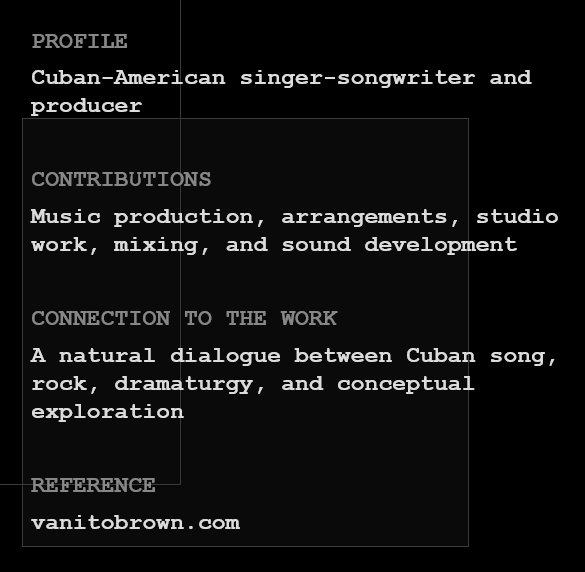
The incorporation of Vanito Brown represents one of the first concrete steps toward the professional dimension that Oliver Stone needs in order to leave the territory of the demo behind and begin finding its definitive sound.
Vanito Brown, born in Palma Soriano, Santiago de Cuba, in 1967, is a Cuban-American singer-songwriter and producer. His career spans several decades of singer-songwriter music, rock, and Cuban alternative music, placing him among the voices associated with the generation that gave rise to Habana Abierta.
His training included studies at Havana’s Instituto Superior de Arte, where he pursued Performing Arts with a focus on dramaturgy, while deepening his knowledge of musical composition, piano, and harmony. That relationship between drama and music is particularly aligned with a project such as Oliver Stone, in which each song is also intended to function as a scene.
During the 1990s, he was part of the 13 y 8 movement and, together with Ale Gutiérrez, led the band "Lucha Almada". He later joined "Habana Abierta", a project through which he developed an extensive recording and performance career, participating in albums released by labels such as BMG Ariola and EMI Odeón.
As a solo artist, he released "Norte Sur Este y Aquel" through Bis Music in 2014 and continued developing production work and collaborations with various Cuban musicians. His career includes projects involving, among others, Aymée Nuviola, Descemer Bueno, Jon Secada, Cimafunk, X Alfonso, and Roberto Carcassés.
This experience does not become part of Oliver Stone as an ornamental element. It brings craftsmanship, musical memory, studio knowledge, and a sensibility born within musical languages that have long had to coexist between Cuban songwriting, rock, experimentation, and the need to tell one’s own reality.
His role within the project will be to accompany Milton García in the search for the album’s definitive sound: working on the songs, arrangements, instrumentation, and the production required to transform the intention contained in the demos into a professional recording.
THE WORK ENTERS PRODUCTION
Up to this point, Oliver Stone exists as a concept, as writing, as composition, and as a series of demos that make it possible to recognize the direction of the songs and the universe to which they belong.
But a demo is still a promise.
It is the possibility of hearing what a work may eventually become before all the elements capable of giving it its definitive dimension have appeared.
The new stage consists precisely of crossing that distance: moving from compositions and demos to a completed musical production; finding the definitive sound of each song, building the arrangements, recording the performances, incorporating the necessary musicians, and developing, around the music, a visual and narrative identity consistent with everything Oliver Stone proposes.
It is at that moment that the vision also requires an economic structure capable of sustaining it.
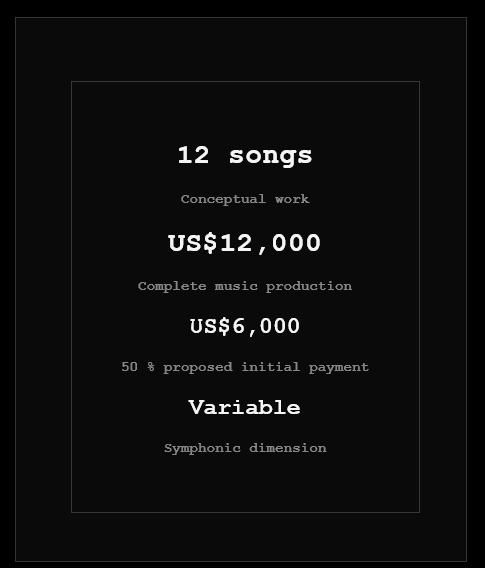
INITIAL MUSICAL PRODUCTION PROPOSAL
The initial proposal received from Vanito Brown to undertake the production of the album establishes an approximate base of US$12,000 for the twelve songs, beginning the process with an initial 50%, equivalent to US$6,000.
From that point forward, the definitive character of the songs, their arrangements, instrumentation, musicians, recording, and all other elements involved in the construction of the album will need to be defined together with the artist.
The symphonic intention also introduces an additional variable. Its cost cannot be considered final until it is determined which songs will require that language, what type of arrangements will be developed, and which musicians or resources will be necessary.
For that reason, the symphonic dimension must be designed selectively and artistically: first the work itself; then, what it truly needs.
BASE WORKING BUDGET
Estimated Working Framework: US$30,000
| AREA | AMOUNT | SCOPE |
|---|---|---|
| Musical production Vanito Brown | US$12,000 | Full musical production of the 12 songs: arrangements, studio, engineering, mixing, mastering, and delivery of final masters. |
| Symphonic arrangements and specialized musicians | US$9,500 | Additional orchestral arrangements, strings, brass, ensembles, and hiring of specialized musicians. |
| Additional musicians and band | US$2,500 | Additional instrumentalists, session musicians, and specific needs not covered by the base production. |
| Image, art, and audiovisual content | US$2,000 | Photography, art direction, and initial promotional materials. |
| Executive production, administration, and legal structure | US$1,500 | Organization, documentation, agreements, and executive coordination. |
| Marketing, distribution, and press | US$2,500 | Launch, distribution, and initial promotional activities. |
TOTAL US$30,000 | US$12,000 base musical production | US$18,000 complementary development
The US$12,000 allocated to full musical production constitute the sonic foundation of Oliver Stone and include production, arrangements, studio work, engineering, mixing, mastering, and delivery of the completed masters.
The remaining US$18,000 make it possible to expand that production toward the complete dimension the project requires.
A significant portion of these resources will be allocated to developing the lbum’s symphonic dimension, including additional orchestral arrangements, the hiring of specialized musicians, strings, brass, ensembles, and other instrumental resources that may be necessary according to the characteristics of each song.
The remainder will make it possible to develop those areas surrounding the music that are equally necessary to transform the album into a professional project: image, audiovisual content, executive production, administrative and legal structure, marketing, distribution, and press..
We are not simply seeking the resources necessary to record twelve songs.
We are seeking the resources necessary to build the project around those twelve songs.
Because producing an album and building a work capable of being presented to an audience, the industry, potential partners, the media, and platforms are two related processes, but they are not identical.
Symphonic dimension
Orchestral arrangements, ensembles, strings, brass, and specialized musicians.
Project del ecosystem
Image, audiovisual content, administrative and legal structure.
Bringing the project to the world
Marketing, distribution, press, and the conditions necessary to reach audiences, media, and the industry.
THE FINANCING WE ARE SEEKING
The project’s initial financing goal is established at US$30,000, according to the base working budget.
That capital may come from a single principal contributor or may be built through different levels of participation, allowing different individuals, entities, or partners to contribute to the development of Oliver Stone according to their possibilities and level of commitment to the project.
We are not merely seeking a transfer of resources.
We seek to establish a relationship in which anyone who chooses to support Oliver Stone can understand what they are helping to build, how the contributed resources will be used, and in what way they may become part of the project’s experience and journey.
Contributions made to the project will be allocated directly to the development of Oliver Stone and will be non-refundable.
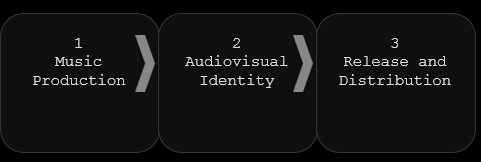
The financing will make it possible to move from the current demo stage toward the professional production of the album, its technical completion, the development of its audiovisual identity, the preparation of its release, and the different actions necessary to present the work to the public, the media, and the industry.
WHAT DOES SOMEONE WHO SUPPORT OLIVER STONE RECEIVE?
Participating in the financing of Oliver Stone means directly contributing to the transformation of a work that currently exists as a concept, compositions, and demos into a completed musical production prepared to find its audience.
The financial contribution made to the project does not constitute a loan and does not create an obligation to repay the contributed capital.
In return, those who contribute to the development of Oliver Stone may receive different benefits and experiences associated with the project, according to the level and nature of their participation.
These benefits may include:
Official credit and recognition within the project, in the materials, publications, or spaces where it is appropriate to acknowledge those who helped make its realization possible.
Privileged access to the development of the work, including selected moments from the creative, musical, and audiovisual process.
Invitations to performances, premieres, concerts, and promotional activities directly related to Oliver Stone.
Early access to selected content, songs, audiovisual materials, or pieces developed around the album before their public release.
Copies and special editions of the project, including physical materials, publications, signed pieces, limited editions, or other items that may be developed throughout the life of the album.
Participation as a guest in selected activities related to the promotion and presentation of the work, whenever the nature of the activity allows it.
Specific benefits may vary according to the size of the contribution and must be defined in advance in the corresponding agreement.
The purpose is for those who help make Oliver Stone possible not simply to remain outside the work after providing resources, but to accompany selected moments of its development and become part of the story that made it possible to turn the project into reality.
ANIMALES ROJOS
Milton García has chosen Animales Rojos as the art house from which Oliver Stone will begin its professional development and projection.
Milton retains the authorship, identity, and artistic direction of the work. Vanito Brown participates through musical production, while Animales Rojos assumes responsibility for the project’s executive development and for building the structure necessary to carry it into its next stage.
Its work includes organizing the professional presentation of Oliver Stone, developing its materials, creating the financing strategy, searching for potential contributors, and establishing connections with producers, musicians, collaborators, institutions, platforms, media outlets, and other strategic partners.
Animales Rojos will also be the structure responsible for presenting the project to those who may contribute to its growth, not only from an economic perspective, but also artistically, promotionally, and strategically.
The intention is to communicate clearly what kind of work is being built, what its identity is, who is involved, what possibilities it contains, and what it can achieve when it finds the appropriate resources.
The search for financing represents a fundamental part of that responsibility. Animales Rojos will work to bring Oliver Stone closer to potential contributors, sponsors, and partners capable of understanding its artistic dimension and considering participation in its development.
At the same time, it will function as a point of coordination between the artist, musical production, collaborators, visual identity, communication, financial resources, and future opportunities for distribution and exposure.
Animales Rojos does not replace Milton García’s voice.
It provides a structure from which that voice can develop, be presented, and find the paths necessary to reach further.
For Oliver Stone, Animales Rojos is the art house from which this stage of the journey begins.
PROJECT SUMMARY
ARTIST
Milton García
────────────────
PROJECT
Oliver Stone
────────────────
FORMAT
12-song concept album
────────────────
CURRENT STATUS
Concept, compositions, and demos
────────────────
PROPOSED MUSICAL PRODUCER
Vanito Brown
────────────────
PROPOSED MUSICAL PRODUCTION
US$12,000
────────────────
PROPOSED INITIAL PAYMENT
50 % · US$6,000
────────────────
TOTAL BASE BUDGET
US$30,000
────────────────
Presentation document prepared for the development of the Oliver Stone project. Figures not supported by formal quotations are presented as working estimates and must be updated before formalizing agreements with third parties.


MONKYOU
La Marea
Proyecto Cimarron 7 de octubre 2022
CONTACT
ANIMALES ROJOS
Art House · Executive Development and Representation of Oliver Stone
Florida, United States
Instagram
@animales_rojos
@anielrafael
Web
animalesrojos.com
Production · Presentations · Collaborations · Press
production@animalesrojos.com
Administration
administration@animalesrojos.com
MILTON GARCÍA · MONKYOU
Artist · Author · Artistic Direction
La Habana, Cuba
Instagram
@miltgarciaa
@monkyou.e
Email
1000tonhabanamadrid@gmail.com
monkyoumusic@gmail.com
Phone
+53 5243 6378
PROJECT INQUIRIES
For proposals involving support, sponsorship, collaboration, production, press, media, and partnerships related to Oliver Stone:
production@animalesrojos.com
OLIVER STONE is an artistic project by Milton García, developed and represented at the executive level by Animales Rojos.